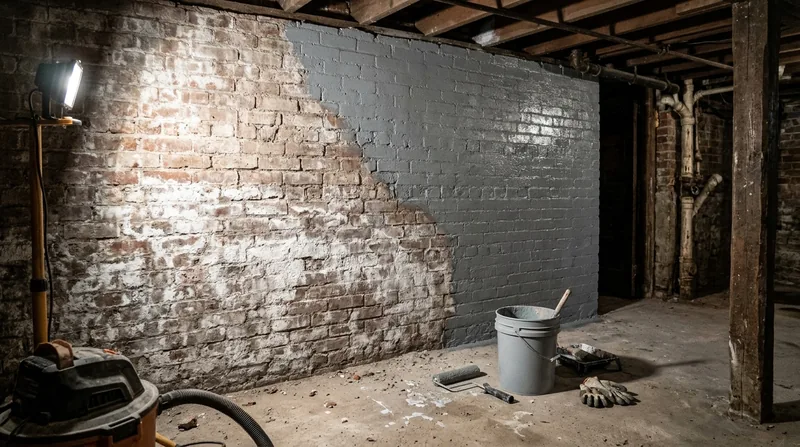




Lexington sits in the Inner Bluegrass on thin phosphatic soil and clay over limestone, and that geology decides how basement walls behave here. In Woodland Park and Aylesford, 1880s to 1920s brick and frame homes sit on old stone or brick foundations with shallow cellars that wick groundwater all spring. Out in Hamburg and Georgetown, poured-concrete walkouts on newer subdivision lots take runoff from grading that has had twenty years to settle. Basement Wall Sealing in Lexington starts with an honest read of which problem you actually have: surface dampness that a sealer handles, or hydrostatic pressure that needs a drainage answer first. We prep, strip efflorescence, and apply penetrating or membrane sealers, and we tell you plainly when sealing alone will not hold. If you want the full picture of how sealing fits into a complete fix, start with our basement waterproofing page.
Why Basement Wall Sealing Matters in Lexington's Old and New Foundations
The dominant failure mode in Lexington is damp masonry, not bulk water. Brick and stone foundations in Chevy Chase and Kenwick are porous, and our humid summers pull moisture through the wall face until white efflorescence blooms and the basement smells musty. Poured walls in Nicholasville and Beaumont show a different pattern: hairline shrinkage cracks that weep after a hard rain. Sealing addresses the first problem well and the second only partly.
- Efflorescence and white salt bloom on brick walls means moisture is moving through the masonry, not just condensing on it.
- Musty basement smell in a finished Lansdowne basement usually traces back to damp wall surfaces behind drywall.
- Wall seepage after rain at the cove joint points to water stacking against the footing, which a sealer cannot stop.
- Freeze-thaw cycles here spall the face of old brick, so sealing a prepared wall slows surface deterioration.
We inspect before we quote, because sealing a wall that is under hydrostatic pressure traps moisture and makes the problem worse.
Key info: A 1920s foursquare in Ashland Park with chalky white bloom and a damp smell gets real results from sealing. A 1990s walkout in Hamburg with water running across the floor after every storm needs drainage first, and we will say so on the spot.
For permit questions on any work that alters drainage or structural elements, verify current requirements with the Lexington-Fayette Urban County Government before work begins.
How We Seal Basement Walls in Lexington, Step by Step
Sealing is only as good as the prep underneath it. We start by finding the source of the moisture, then we work the wall surface until the sealer can bond. On old brick we are careful with abrasive prep, because the mortar joints are softer than the units and a heavy hand does more harm than good.
- We walk the basement and the exterior grade, checking downspout extensions, grading slope, and any sign of water at the cove joint.
- We remove efflorescence with a dry brush and a mild acid wash, then let the masonry dry to a workable moisture level.
- We patch spalled mortar joints and voids with a compatible repair mortar before any sealer goes on.
- We apply a penetrating sealer on brick and stone, or a membrane coating on poured walls where surface dampness is the issue.
- We note any crack that needs epoxy or polyurethane injection and quote it separately rather than hiding it under a coat of sealer.
Every job ends with a written note on what we sealed, what we left alone, and what to watch for next spring.
Key info: A Versailles cottage on a rubble stone foundation had three failed DIY sealer coats. We stripped them, repointed the mortar, and applied a breathable penetrating sealer. The wall dried out because we let it breathe instead of capping it.
If the inspection turns up water at the footing rather than the wall face, the right answer is usually an interior drain tile system, and we will tell you that before you spend money on sealer.
Sealing Approaches We Use and When Each One Fits
Not every wall takes the same product. Brick, stone, poured concrete, and block all behave differently, and the wrong sealer on an old foundation can trap moisture and spall the face. This table shows how we match the approach to the wall.
| Approach | Description | Best for |
|---|---|---|
| Penetrating sealer | Sinks into the masonry and blocks capillary movement while leaving the wall able to breathe. | Old brick and stone foundations with surface dampness and efflorescence. |
| Membrane coating | A flexible cementitious or polymer coating that bridges hairline cracks and seals the face. | Poured concrete walls in newer builds with minor seepage. |
| Repoint and seal | We cut out failed mortar, repack it with a compatible mix, then seal the whole face. | Rubble stone and soft brick where joints have eroded. |
| Crack injection first | Epoxy or polyurethane injection closes an active crack before any sealer is considered. | Walls with a defined weeping crack and no broad dampness. |
We choose the approach after the inspection, not before, because the wall tells us what it needs.
Basement Wall Sealing Cost in Lexington: What to Expect
Pricing for wall sealing starts at $1,500 for a typical single-wall or small basement job with standard prep. From there, the number moves with wall length, how much efflorescence and failed mortar we have to strip, and whether cracks need injection before sealing. A small poured wall in a newer Nicholasville home sits near the bottom of the range. A full perimeter on an old stone foundation in Woodland Park with heavy repointing sits well above it.
Access matters too. Basements with low headroom, mechanical clutter, or finished walls that need protection slow the work and add labor. If the inspection finds hydrostatic pressure, we quote drainage separately and honestly rather than padding a sealer job that will not solve the problem. Get two or three written estimates and compare what each one includes, not just the bottom line.
Our full pricing overview breaks down the ranges by scope so you can compare quotes like for like.
Hiring a Basement Wall Sealing Contractor Near Me in Lexington
Anyone can buy a bucket of sealer and a sprayer. What separates a real contractor is diagnosis, prep, and knowing when to stop. Ask for proof of licensing and insurance, and ask what the crew will do if the wall turns out to be under pressure. A contractor who only sells sealer will sell you sealer.
- Confirm the company is licensed and insured, and ask for a certificate before work starts.
- Get at least two written estimates that specify prep steps, products, and what is excluded.
- Ask for references from jobs on similar wall types, not just similar neighborhoods.
- Check whether any structural or drainage work in your scope needs a permit from the local building department.
- Read your HOA rules on exterior work and discharge lines before scheduling.
A straight answer about what sealing will and will not fix is the best sign you have found the right crew.
Reach out through our contact page to schedule a free basement inspection and get a written scope before you commit.
Basement Wall Sealing in Lexington: Pricing Guide
| Service | Price | Details |
|---|---|---|
| Single wall, standard prep | Starting at $1,500 | Includes efflorescence removal, minor mortar patching, and sealer on one wall face. |
| Full basement perimeter | From $2,800 | Covers all four walls, with price driven by wall length and degree of spalling. |
| Old stone or soft brick foundation | On estimate | Repointing and breathable sealer require an on-site look before a number is given. |
| Crack injection before sealing | Quoted separately | Active cracks are injected with epoxy or polyurethane before any sealer is applied. |
| Travel | Included | in Lexington and surrounding areas, no separate call-out or mileage fee |
| Estimate | Free | Response within 24h at (859) 710-8035, no obligation to book |
Indicative pricing, the exact cost depends on square footage, finish, and site access. Free personalized estimate within 24h at (859) 710-8035.


