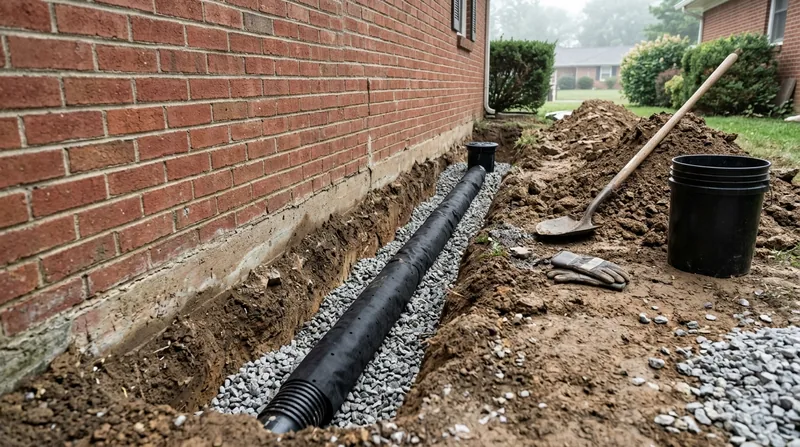




French Drain Installation in Lexington is the work we do most on the rolling lots east of downtown and along the Town Branch watershed, where water from uphill lots, driveways and old limestone foundations has nowhere to go but down. Lexington sits on thin phosphatic soil and clay over limestone, with karst sinkholes, springs and buried streams running under neighborhoods like Chevy Chase, Ashland Park and the 1950s ranches of Meadowthorpe. When spring rains hit, that water funnels against downhill walls and into shallow cellars in the 1880s-1920s Victorians and foursquares around Woodland Park. A properly built exterior drain intercepts that groundwater before it reaches the footing, instead of letting hydrostatic pressure find every crack in a brick or poured wall. If you are already seeing seepage, start with a basement waterproofing assessment so we can tell you whether a drain alone solves it or whether the wall needs crack repair too.
Why French Drains Matter on Lexington's Karst and Clay
Lexington's Inner Bluegrass ground is a two-layer problem: thin topsoil over phosphatic clay, then limestone bedrock riddled with solution channels. Rain percolates fast until it hits clay, then moves laterally along the footing and against your wall. In the older brick neighborhoods, the footing drains installed in the 1920s are often clay tile that has collapsed or silted solid, so the water has no path out.
- Uphill runoff from Georgetown and Versailles lots sheets across grade and ponds against the low side of a walkout basement.
- Freeze-thaw winters open hairline cracks in parging and mortar joints, giving water a direct route into the block.
- Buried streams like Town Branch and Cardinal Run raise the local water table after heavy spring storms.
- Sinkholes and karst pockets swallow discharge water and can back up during flash flooding.
When those conditions line up, no amount of interior patching stops the water. The drain has to go in outside the wall and carry it away.
Key info: On a Chevy Chase Tudor with a shallow cellar, we routinely find the original weeping tile crushed under a 1940s concrete patio. The drain we install runs outside the footing, wrapped in filter fabric and graded gravel, and ties to daylight at the low corner of the lot.
For the permit side, drainage work that alters stormwater flow or ties into a sump discharge can require review. Verify current rules with the Lexington-Fayette Urban County Government before work begins.
How We Install a French Drain on a Lexington Foundation
We start by walking the grade with a laser level and mapping where water actually arrives. On rolling lots in Lansdowne and Beaumont, that means tracing the swale from the neighbor's yard, not just looking at your own downspouts. Then we excavate, lay the pipe, and restore the surface so the yard drains away from the wall instead of toward it.
- We locate the footing and existing drain tile with a probe and hand-dig near utilities.
- We excavate a trench along the wall, sloped to a positive fall of at least one percent.
- We line the trench with filter fabric to keep glacial clay from silting the gravel.
- We set perforated pipe in washed gravel, holes down, and wrap the fabric over the top.
- We tie the run to daylight or to a sump basin with a check valve on the discharge line.
- We backfill, compact, and regrade so surface water sheds away from the foundation.
Every run gets a flow test before we close the trench, so we know the water leaves the property.
Key info: A Hamburg walkout with a poured wall was taking water at the rear corner every March. The uphill neighbor's sump discharge ran straight toward the property line. We ran a 70-foot exterior drain to a daylight outlet at the curb and extended the neighbor-side downspouts, and the corner has stayed dry through two spring seasons.
If the drain ties into a sump basin, pair it with a reliable sump pump installation so the basin empties during the storm, not after it.
Drain Approaches We Use Across Lexington Properties
Not every lot needs the same system. A downtown Victorian with a shallow cellar and a tight side yard is a different job from a 2010s Nicholasville subdivision with a full walkout and finished lower level. We match the approach to the grade, the wall type, and where the water can legally discharge.
| Approach | Description | Best for |
|---|---|---|
| Exterior footing drain to daylight | Gravel and perforated pipe along the footing, fabric wrapped, sloped to a low outlet | Rolling lots with a downhill discharge point |
| Exterior drain to sump basin | Same trench, piped into a sealed basin with a pump and check valve | Flat lots and karst pockets with no gravity outlet |
| Interior perimeter drain | Channel cut at the wall-footing joint, leading to a basin | Finished basements where exterior excavation is impractical |
| Surface swale and downspout correction | Regrading and extending downspouts to move roof water away from the wall | Minor seepage and homes with short downspout runs |
We tell homeowners plainly when a swale and downspout extension is enough, and when the wall is under real hydrostatic pressure and needs a full drain.
French Drain Installation Cost in Lexington: What to Expect
Most exterior drain work in Lexington starts around From $25 per linear foot, and the final number depends on how deep the footing sits, how much hand-digging is needed near utilities, and whether the run goes to daylight or into a sump basin. A 40-foot run on a Versailles ranch is a smaller ticket than a 90-foot run around a Hamburg walkout with a pump added. Access matters too: a tight side yard in Kenwick means more labor than an open lot in Beaumont.
We recommend getting two or three written estimates and comparing scope, not just the bottom line. One quote may include regrading and downspout work; another may not. Ask what happens to the discharge water and whether the price covers restoring the lawn and walkway.
Our full pricing overview breaks down the variables in more detail.
French Drain Installation Near Me: How to Vet a Lexington Contractor
Searching for French drain installation near me in Lexington turns up plenty of general excavators and landscapers. Below-grade drainage is its own trade, and the details matter: fabric wrap, gravel grade, pipe slope, and a discharge plan. Ask each bidder the same questions and compare the answers side by side.
- Confirm the contractor is licensed and insured in Kentucky and ask for a certificate before work starts.
- Request two or three local references from jobs in Lexington, Georgetown or Nicholasville.
- Ask whether the quote includes regrading, downspout extensions and lawn restoration.
- Check who pulls any required permit for drainage or sump discharge work.
- Get the discharge point in writing, since karst sinkholes and buried streams can complicate where water can go.
A contractor who cannot explain where the water leaves your property is guessing. Reach out through our contact page and we will walk the lot with you.
French Drain Installation in Lexington: Pricing Guide
| Service | Price | Details |
|---|---|---|
| Exterior French drain to daylight | Starting at $25/linear ft | Includes excavation, filter fabric, washed gravel, perforated pipe and regrading to a downhill outlet |
| Exterior drain tied to sump basin | Starting at $32/linear ft | Adds a sealed basin, pump, check valve and discharge line for flat or karst lots |
| Interior perimeter drain | Starting at $30/linear ft | Wall-footing channel cut and tied to a basin, best for finished basements with no exterior access |
| Downspout and grading correction | Starting at $450 | Extends downspouts and regrades soil so roof water sheds away from the wall |
| Complex or large-scale job | On estimate | Deep footings, tight side yards, hand-digging near utilities and multiple discharge points need an on-site look |
| Estimate | Free | Response within 24 hours at (859) 710-8035, no obligation to book |
Indicative pricing, the exact cost depends on square footage, finish, and site access. Free personalized estimate within 24h at (859) 710-8035.


