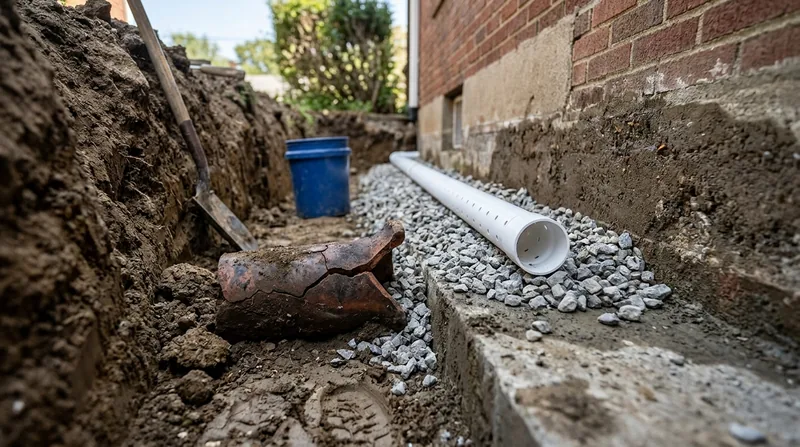




Lexington sits on thin phosphatic soil and clay over limestone, and that geology decides how water moves under your house. In the older neighborhoods like Woodland Park, Aylesford and downtown, many homes still run on original clay tile footing drains installed before 1960. Those tiles crack, silt up and get root-bound by the maples and oaks that shade the brick streets. In Hamburg, Beaumont and the newer Georgetown subdivisions, poured-concrete foundations sit on graded lots where runoff from uphill neighbors funnels straight toward the footing. Drain Tile Repair & Replacement in Lexington is the work of restoring that buried perimeter drain so groundwater reaches the sump basin instead of your basement floor. We camera-inspect, excavate only where needed and replace failed clay or orangeburg tile with modern perforated PVC. Call (859) 710-8035 to schedule a free basement inspection and find out what is actually under your slab. If the water is already inside, start with our interior drain tile system page to understand the full perimeter approach.
Why Failing Drain Tile Is the Hidden Cause of Wet Basements Across Lexington
Most Lexington basements that seep after spring rain are not failing at the wall. They are failing at the footing, where a 70-year-old clay tile line has collapsed or filled with sediment. When that line stops flowing, hydrostatic pressure builds against the foundation wall and water finds the weakest point: a cold joint, a tie-rod hole or a hairline crack. The Inner Bluegrass karst geology makes it worse. Sinkholes, springs and buried streams like Town Branch and Cardinal Run concentrate water in low pockets, and a drain tile that daylights into a dry sinkhole can back up when the water table rises.
- Clay tile from the 1930s to 1960s cracks at the joints and silts shut, so water pools against the footing instead of draining.
- Tree roots from mature street trees enter through open joints and slowly choke the line until flow stops completely.
- Original tile often discharges to a storm connection or daylight outlet that has since been blocked or regraded.
- Freeze-thaw winters heave shallow tile runs and open new breaks that go unnoticed until the first heavy spring rain.
- Downspouts and grading that concentrate runoff against a downhill wall overload a drain tile that was never sized for that volume.
In every one of these cases, sealing the visible crack without restoring the drain does not solve the problem, because the water still has nowhere to go.
Key info: A 1950s brick ranch in Lansdowne with a damp floor along one wall usually has a failed clay tile line on that side, not a wall problem. Camera inspection confirms it before anyone digs.
Permits and drainage regulations vary by jurisdiction, so confirm requirements with the Lexington-Fayette Urban County Government before any work that alters drainage or the sanitary connection of a sump discharge.
How We Diagnose and Replace a Failed Drain Tile in Lexington
We do not guess at the location of a drain tile. We run a camera through the existing line and map the breaks, root intrusions and low spots before we quote anything. That matters in Lexington, where a Chevy Chase Tudor may have a partial clay tile run on two sides and nothing on the other two. It also matters in Nicholasville and Georgetown, where newer homes have corrugated black pipe that crushed under backfill. The goal is targeted excavation, not a full perimeter dig when the failure is isolated.
- We camera-inspect the existing line and mark the depth, slope and failure points on the foundation wall.
- We excavate only the failed run, keeping the trench tight to the footing to protect mature trees and established landscaping.
- We remove the collapsed clay or orangeburg tile and any root mass choking the line.
- We install perforated PVC with a proper gravel and filter fabric envelope, then re-establish correct slope to the sump basin or daylight outlet.
- We tie the discharge into the sump system, verify the check valve and run water through the line before backfilling.
- We restore grading and downspout extensions so runoff moves away from the wall instead of back into the trench.
Every repair ends with a flow test, because a drain tile that is not verified under water is not finished.
Key info: On a 1920s foursquare near Ashland Park, we found a clay tile line that had been capped off decades earlier and replaced by nothing. Water had been running against the footing ever since. A 30-foot PVC replacement and a new sump connection dried the floor in one day.
For homes in the 40502 ZIP code, see our Drain Tile Repair & Replacement in Lexington (40502) page for neighborhood-specific notes on older foundations.
Repair Methods We Use and When Each One Fits
Not every failing drain tile needs the same treatment. A single collapsed section under a stoop is a different job from a root-bound line running the length of a basement wall. The table below shows the approaches we use and the conditions that call for each one. We choose based on the camera findings, the depth of the footing and how much access the lot allows.
| Approach | Description | Best for |
|---|---|---|
| Targeted spot repair | Excavate and replace one collapsed or root-bound section of tile, leaving sound runs in place. | Isolated breaks confirmed by camera, tight lots, mature landscaping. |
| Full run replacement | Remove the entire failed clay line and install new perforated PVC with gravel envelope. | Long runs of collapsed 1940s to 1960s clay tile, chronic seepage along one wall. |
| Interior perimeter drain | Cut a channel inside the basement floor along the footing and pipe water to a sump basin. | Exterior excavation is impractical, or the footing drain cannot be restored. |
| Sump connection and discharge | Tie the restored tile into a sump basin with a pump, check valve and discharge line. | Any drain tile that cannot daylight to grade, common on flat Lexington lots. |
| Camera inspection only | Diagnostic run to locate breaks, roots and slope problems before any excavation. | First step on every job, and useful when a homeowner needs a second opinion. |
We recommend the least invasive method that actually restores flow, and we say so plainly when a spot repair will not hold.
Drain Tile Repair & Replacement Cost in Lexington: What to Expect
Pricing for drain tile work starts from $750 for a targeted spot repair with camera inspection included. From there, cost depends on how much tile has to come out and how hard it is to reach. A short run under a driveway or a finished basement floor costs more than the same length in an open yard. Full perimeter replacement on a large foundation, or a job that requires tying into a new sump basin, sits at the upper end of the range. We give a written number after the camera inspection, not before.
Getting two or three estimates is smart, but make sure each one includes a camera inspection. A contractor who quotes a drain tile replacement without looking inside the line is guessing. Ask whether the price includes the gravel envelope, the sump connection and disposal of the old tile. Our full pricing overview breaks down what each scope includes so you can compare quotes line by line.
Drain Tile Repair & Replacement Near Me: Hiring a Contractor Near Lexington
When you search for drain tile repair near me, the results all look similar. What separates a real waterproofing specialist from a general handyman is the diagnostic step, the insurance and the willingness to tell you when a simpler repair is enough. Ask for the license and insurance certificate before work starts, and confirm the company carries general liability and workers compensation. Ask for two or three recent references in Lexington, ideally on homes built in the same era as yours.
Permits may be required when work alters drainage or the sanitary connection of a sump discharge, and rules vary by jurisdiction, so confirm with the local building department. If your home is in a neighborhood association, check any requirements before excavation. Reach out through our contact page to schedule a free inspection and get a written scope.
Drain Tile Repair & Replacement in Lexington: Pricing Guide
| Service | Price | Details |
|---|---|---|
| Targeted spot repair | Starting at $750 | Camera inspection, excavation of one failed section, new PVC and flow test included |
| Single wall run replacement | Starting at $1,800 | Full clay tile replacement along one foundation wall with gravel envelope and disposal |
| Full perimeter replacement with sump tie-in | On estimate | Scope depends on footage, depth, access and whether a new sump basin is required |
| Camera inspection only | Starting at $250 | Diagnostic run with written findings and photos, credited toward repair if you proceed |
| Travel | Included | In Lexington and surrounding areas, no separate call-out or mileage fee |
| Estimate | Free | Response within 24h at (859) 710-8035, no obligation to book |
Indicative pricing, the exact cost depends on square footage, finish, and site access. Free personalized estimate within 24h at (859) 710-8035.


