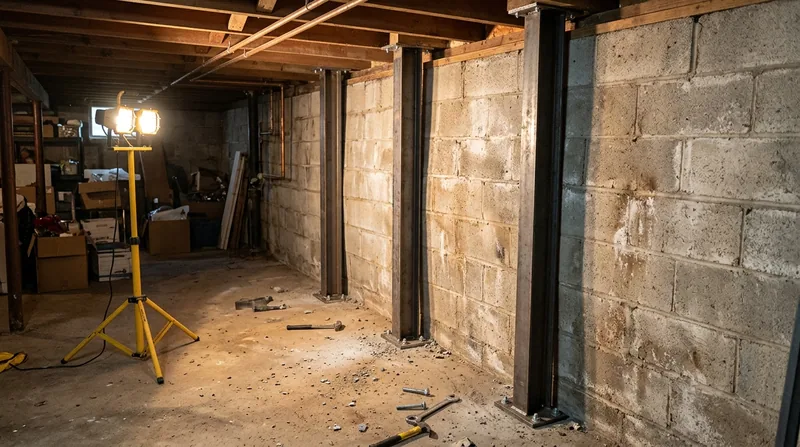




A Bowing Wall Repair in Lexington is not a cosmetic fix. When a basement wall leans inward, the cause is almost always saturated clay soil pushing against a foundation that was never designed for that load. Lexington sits on thin phosphatic soil and clay over limestone, and the old stone and brick cellars in Woodland Park, Aylesford and the downtown neighborhoods were built shallow and without modern drainage. Spring rain soaks the clay, the water table rises, and hydrostatic pressure finds the weakest point in the wall. We stabilize bowing walls with carbon fiber straps, steel I-beams or wall anchors, matched to how far the wall has moved and what the soil is doing. If you are seeing a lean, a horizontal crack at mid-wall, or doors that no longer close square, start with a free basement inspection before the movement gets worse.
Why Bowing Walls Show Up So Often in Lexington's Older Basements
Most of the bowing walls we see in Lexington are in 1920s to 1950s brick Tudors, Colonials and cottages in Ashland Park, Chevy Chase and Kenwick, where the original footing drains have long since clogged with clay and root fibers. The wall takes the load, the mortar joints open, and efflorescence appears where water pushes through. In the 1950s to 1970s brick ranches across Meadowthorpe, Lansdowne and Beaumont, we often find block walls that were backfilled with the same clay that was excavated, which holds water against the wall year after year.
- Saturated glacial clay soil presses inward on the wall and does not drain on its own.
- Clogged or collapsed footing drains let the water table rise against the foundation.
- Freeze-thaw cycles open existing cracks wider each winter.
- Downspouts that discharge within a few feet of the wall concentrate runoff at the worst spot.
- Karst sinkholes and buried streams like Town Branch and Cardinal Run funnel water into low pockets.
None of these are cosmetic problems, and none of them fix themselves once the soil is saturated.
Key info: On a 1948 brick Colonial in Chevy Chase, the rear basement wall had moved about 1.5 inches inward at mid-height. The footing drain was full of clay, and the downspout dumped directly against the wall. We anchored the wall and corrected the discharge before the movement could progress.
For the official position on structural permits and inspection requirements, check the Lexington-Fayette Urban County Government building department before any structural work begins.
How We Diagnose and Repair a Bowing Wall in Lexington
We do not quote a bowing wall repair from a photo. The first step is measuring the actual deflection along the wall, checking for horizontal cracking and reading the soil and drainage conditions around the foundation. A wall that has moved less than an inch and has stopped moving is a different job from one that is still creeping inward after every wet spring. We match the repair to the severity, not to a standard package.
- We measure the wall deflection and map cracks, efflorescence and moisture at the base.
- We inspect the footing drain, downspout discharge and grading on the wet side of the wall.
- We recommend carbon fiber straps for stabilization, steel I-beams for heavier loads, or wall anchors where the wall must be pulled back.
- We correct the water source with drainage work so the repaired wall is not fighting the same pressure.
- We verify the repair and leave you with a clear record of what was done and what to watch.
The repair only holds when the water that caused the pressure is managed, which is why drainage and wall stabilization go together on most Lexington jobs.
Key info: A 1962 split-level in Lansdowne had a block wall bowing near the sump basin. The sump pump ran constantly in spring, and the discharge line emptied against the foundation. We stabilized the wall and rerouted the discharge well away from the house.
If the diagnosis points to water management rather than structural movement alone, the right next step is often an interior drain tile system that relieves the pressure at the base of the wall.
Bowing Wall Repair Methods We Use in Lexington
Each method solves a different problem. Carbon fiber straps resist further inward movement, steel I-beams carry heavier loads, and wall anchors are the only option that can pull a wall back toward plumb. We choose based on deflection, wall material and soil pressure.
| Approach | Description | Best for |
|---|---|---|
| Carbon fiber straps | Straps bonded to the wall from floor to sill, holding the wall against further inward movement. | Block or poured walls with moderate bowing and no need to pull back. |
| Steel I-beams | Vertical steel beams set against the wall and tied into the floor and joists. | Heavier loads, deeper bowing, and walls that need rigid support. |
| Wall anchors | Anchors set in the soil outside pull the wall back toward plumb over time. | Walls that have moved significantly and can be straightened. |
| Drainage correction | Footing drain repair, downspout extensions and grading to reduce hydrostatic pressure. | Any bowing wall where saturated clay is the driving cause. |
The structural repair and the drainage correction are planned together, because a stabilized wall still fails if the clay stays saturated.
Bowing Wall Repair Cost in Lexington: What to Expect
Bowing wall repair is priced by the linear foot of wall, the method, and how much drainage correction is needed. A single wall with moderate movement and carbon fiber straps is a different number from a full wall anchor job with footing drain work. As a starting point, minor stabilization work begins around $600, and the figure climbs with wall length, access and soil conditions. We give a written scope before any work starts so you know what is included.
Get two or three estimates and compare the scope, not just the number. A quote that ignores the water source is not the same job as one that addresses it. Our pricing overview explains how we build an estimate.
What to Look For When Hiring a Bowing Wall Repair Contractor Near Lexington
Ask for proof of license and insurance before anyone walks the basement. A structural repair contractor should be able to explain the method, show references from similar Lexington homes, and tell you plainly when a simpler fix is enough. Structural foundation repair commonly requires a permit, and the rules vary by jurisdiction, so confirm with the local building department. If your home is in a historic district or under an HOA, check those requirements before work begins.
Call Lexington Waterproofing at (859) 710-8035 to schedule an inspection.
Bowing Wall Repair in Lexington: Pricing Guide
| Service | Price | Details |
|---|---|---|
| Carbon fiber strap stabilization | Starting at $600 | Covers minor stabilization on a short wall section, priced up by wall length and access. |
| Steel I-beam installation | Starting at $1,200 | Includes beam set and tie-in, with cost driven by wall height and number of beams. |
| Wall anchor system | On estimate | Requires an on-site look at deflection, soil and exterior access before a number is given. |
| Drainage correction add-on | On estimate | Footing drain repair, downspout extensions and grading priced after the water source is confirmed. |
| Travel | Included | In Lexington and surrounding areas, no separate call-out or mileage fee. |
| Estimate | Free | Response within 24h at (859) 710-8035, no obligation to book. |
Indicative pricing, the exact cost depends on square footage, finish, and site access. Free personalized estimate within 24h at (859) 710-8035.


