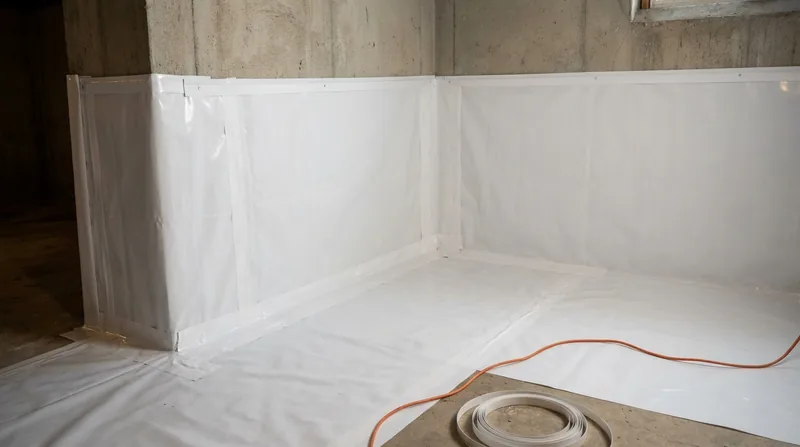




Vapor Barrier Installation in Lexington
Lexington sits in the Inner Bluegrass on thin phosphatic soil and clay over limestone, and that geology pushes groundwater vapor straight through the porous block and poured walls of homes from the 1880s brick Victorians in Woodland Park to the 1990s walkout basements in Hamburg. Vapor Barrier Installation in Lexington is the below-grade answer to that constant, invisible moisture drive: heavy-duty sheets sealed across the walls and slab to stop ground vapor before it reaches the living space. We install dimple board and heavy-duty vapor barrier on old stone foundations in Aylesford, brick Tudors in Ashland Park, and poured walls in Georgetown and Nicholasville. If you already see efflorescence or smell a musty basement after spring rain, start with a free basement inspection so we can trace the vapor source before we quote sheet coverage.
Why Vapor Barrier Installation Matters in Lexington's Karst and Clay
Karst sinkholes, springs, and buried streams like Town Branch and Cardinal Run keep the water table close to many Lexington footings, and the glacial clay soil holds that moisture against the wall instead of letting it drain away. Heavy spring rain and flash flooding in low pockets push vapor through brick, stone, and block faster than any coating can stop it. The result is the wet basement pattern we see across Chevy Chase and Kenwick: damp lower walls, white efflorescence, and a musty smell that returns every humid summer.
- Ground vapor migrates through unsealed block and old brick mortar joints and condenses on cool basement surfaces.
- Clay soil traps water against the footing, so hydrostatic pressure drives moisture inward even when the wall looks dry.
- Freeze-thaw winters open hairline cracks that let vapor and liquid water pass together.
- Downspout extensions that stop short of the grade drop roof runoff right back against downhill walls.
A properly sealed vapor barrier closes those paths at the wall and slab, which is the first step before any finish work goes in.
Key info: In Meadowthorpe and Lansdowne, 1950s brick ranches with partly finished basements often show vapor damage behind paneling. We pull a small section, check the wall for active seepage, and seal the barrier directly to the masonry rather than trapping moisture behind new framing.
Permits for work that alters drainage or ties into a sump discharge vary by jurisdiction, so always confirm the current requirements with the Lexington-Fayette Urban County Government before scheduling.
How We Install Vapor Barriers in Lexington Basements
We start by mapping where the moisture actually comes from, because a barrier over an active leak traps water and makes the problem worse. On old stone and brick foundations we check mortar condition and parging first, then decide whether the wall needs sealing before the sheet goes up. Every job is sequenced so the barrier ties cleanly into the perimeter drain and sump basin.
- We inspect the walls, slab, and footing drain, and we test for active seepage versus condensation vapor.
- We repair cracks and parge rough masonry so the barrier has a continuous surface to seal against.
- We install dimple board against the wall to create a drainage gap and protect the vapor sheet.
- We hang heavy-duty barrier sheets with sealed seams and taped terminations at the rim and slab.
- We integrate the barrier with the sump basin and check valve so collected moisture exits the building.
- We grade and extend downspouts away from the foundation to reduce the vapor load at the source.
Each step is documented so you can see exactly where the barrier terminates and how it ties into your drainage.
Key info: A Versailles home on a poured walkout wall had a finished lower level with a persistent musty smell. The barrier was missing at the slab-to-wall joint, so we sealed the seam, tied it to the existing sump pump installation, and the moisture readings dropped within two weeks.
Vapor Barrier Methods We Use Across Lexington
The right approach depends on your foundation type, how finished the basement is, and whether the water problem is vapor alone or vapor plus active seepage. We match the method to the wall, not the other way around. The table below shows what we typically install and where each method fits.
| Approach | Description | Best for |
|---|---|---|
| Wall dimple board plus vapor sheet | Rigid dimple mat against the wall with a sealed heavy-duty barrier over it, creating a drainage gap and a vapor stop. | Poured and block walls with condensation and efflorescence. |
| Full wall and slab encapsulation | Barrier sheets run continuous from rim to slab with taped seams and a sealed slab termination. | Finished basements where vapor control must be complete. |
| Sump-integrated barrier | Barrier tied into the sump basin and check valve so collected moisture drains out instead of pooling. | Basements with an existing interior drain tile system. |
| Masonry seal and parge before barrier | Crack repair, parging, and a waterproof membrane applied before the vapor sheet goes up. | Old stone and brick foundations in Woodland Park and Aylesford. |
We recommend the method only after the inspection confirms where the vapor is entering.
Vapor Barrier Installation Cost in Lexington: What to Expect
Most Lexington vapor barrier jobs start around $3 per square foot of wall and slab coverage, and that figure moves with wall condition, access, and whether the barrier ties into a sump system. Old stone foundations in the downtown neighborhoods need more prep than a clean poured wall in Hamburg, and that prep is the biggest cost driver. We give you a written scope before any sheet is cut.
Factors that raise the number include rough or failing parging, active seepage that must be stopped first, low headroom that slows installation, and a finished basement where we have to work around framing and stored items. Getting two or three estimates is smart because it forces each contractor to explain what they will actually seal and where the barrier terminates. You can see how the line items break down on our pricing page before you call.
Vapor Barrier Installation Near Me: How to Hire in Lexington
When you search for vapor barrier installation near me in Lexington, the contractor you pick should be able to explain the difference between vapor control and active water repair without selling you a full excavation you do not need. Ask for proof of licensing and insurance, and confirm the crew that shows up is the crew that quoted the work. Check references from neighborhoods with your foundation type, and ask how they handle permits if the job touches drainage or the sump discharge.
- Confirm the company is licensed and insured, and request a certificate before work begins.
- Get at least two written estimates with a clear scope and termination points.
- Ask for references from Lexington homes with similar foundations and moisture symptoms.
- Verify who pulls any required permit with the local building department.
If the answers are vague, keep calling. You can reach us through the contact page when you are ready for a straight assessment.
When Vapor Control Is Not Enough
If water is actually standing on the slab or running down the wall after rain, a vapor barrier alone will not fix it. That pattern points to hydrostatic pressure and a failed footing drain, and the right answer is usually an interior drain tile system before any sheeting goes up. We tell you plainly which problem you have, and we do not sell barrier work over an active leak.
Call (859) 710-8035 to schedule a free basement inspection and get a clear, written recommendation for your Lexington home.
Vapor Barrier Installation in Lexington: Pricing Guide
| Service | Price | Details |
|---|---|---|
| Wall dimple board and vapor sheet | Starting at $3/sq ft | Includes dimple mat, sealed barrier sheet, and taped terminations; rough parging or low headroom raises the rate. |
| Full wall and slab encapsulation | Starting at $4/sq ft | Continuous rim-to-slab coverage with sealed seams; finished basements with framing and stored items move the price up. |
| Sump-integrated barrier | Starting at $3.50/sq ft | Barrier tied into the sump basin and check valve; existing drain tile condition and pump replacement add cost. |
| Masonry prep and parge before barrier | On estimate | Old stone and brick foundations need crack repair and parging assessed on site before a barrier number is given. |
| Travel | Included | In Lexington and surrounding areas, no separate call-out or mileage fee. |
| Estimate | Free | Response within 24h at (859) 710-8035, no obligation to book. |
Indicative pricing, the exact cost depends on square footage, finish, and site access. Free personalized estimate within 24h at (859) 710-8035.


