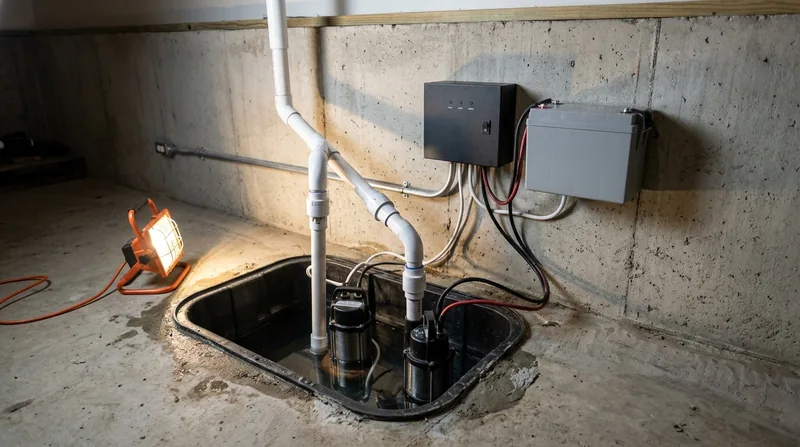




When a summer thunderstorm rolls across the Inner Bluegrass and knocks out power in Chevy Chase or Hamburg, your sump pump stops with the lights. That is the exact hour water starts rising in the basin. Battery Backup Sump Pumps in Lexington keep the impeller turning on DC power so a wet basement does not become a flooded one while you wait for Kentucky Utilities to restore the grid. We size the backup to your pit, your pumping head, and the volume your primary pump moves, then wire it so it charges automatically and alarms when something drifts. If your primary pump is already tired, start with sump pump installation and replacement and we will set the backup on top of a sound system.
Why Lexington Basements Lose Power and Water at the Same Time
Lexington sits on thin phosphatic soil and clay over limestone, with karst sinkholes, springs, and buried streams like Town Branch and Cardinal Run running under old neighborhoods. Spring rain and flash flooding in low karst pockets push the water table up fast, and the sump basin fills in minutes, not hours. The storm that floods your pit is usually the same storm that takes down the feeder line, so a pump with no battery is a pump that quits when it is needed most.
- 1880s to 1920s brick and frame homes in Woodland Park and Aylesford often have shallow cellars and old stone foundations that collect water quickly.
- 1920s to 1950s Tudors and Colonials in Ashland Park and Kenwick have full basements where a failed pump means inches of standing water against the wall.
- 1950s to 1970s ranches and split-levels in Meadowthorpe and Lansdowne have partly finished basements with sump pits that are often undersized for a heavy storm.
- 1990s to 2020s subdivision homes in Hamburg, Nicholasville, and Georgetown have poured-concrete walkout basements where the pit runs more often than the original owner expected.
A backup pump buys you hours of pumping during an outage, and that window is usually the difference between a damp floor and a ruined finished basement.
Key info: In a 2022-style ice storm across Fayette County, homes in Chevy Chase and Ashland Park sat without power for days. Basements with a battery backup stayed dry; basements on grid power alone took on water within the first afternoon.
For official guidance on electrical work and permits around pump circuits, check the Lexington-Fayette Urban County Government building services pages before you schedule.
How We Install a Battery Backup Sump Pump in Lexington
We treat the backup as a second pump, not an accessory. The goal is a system that runs on its own battery, discharges through its own line, and tells you when the charge drops or the float sticks. We check the pit depth and diameter, measure the static head on the discharge, and match the backup to the inflow your primary pump handles during a spring storm.
- We inspect the existing sump basin, check valve, and discharge line to confirm the pit can take a second pump.
- We set the backup pump on a stand or bracket so it sits above sediment and below the primary float.
- We run a separate discharge line with its own check valve so the two pumps do not fight each other.
- We mount the charger and battery in a dry spot, wire the float switch, and test the alarm.
- We fill the pit with water and watch both pumps cycle to confirm the backup takes over when the primary is unplugged.
Every install ends with a live test, not a handshake, because a backup that has never run is a guess.
Key info: A Beaumont split-level with a 24-inch pit and a 1/3 HP primary pump needed a 1/2 HP backup with a group 27 battery to handle the inflow from a Cardinal Run tributary during a March rain. We sized it on site, not from a catalog page.
If the pit itself is failing or the drain tile is clogged, the backup will just cycle against a losing battle. In that case we recommend drain tile repair and replacement before adding equipment.
Approaches We Use for Battery Backup Sump Pumps in Lexington
Not every basement needs the same hardware. A shallow cellar in Aylesford and a deep walkout pit in Georgetown pull different volumes, and the battery chemistry matters as much as the pump. Here is how we match the approach to the house.
| Approach | Description | Best for |
|---|---|---|
| Integrated backup pump | A DC pump and charger built into one unit that mounts beside the primary pump in the same basin. | Finished basements in Chevy Chase and Kenwick where space in the pit is tight. |
| Separate backup pump with dedicated discharge | A standalone DC pump, its own check valve, and a separate line out of the house. | Homes in Meadowthorpe and Lansdowne with high inflow and a primary pump that runs often. |
| Battery plus charger and alarm package | A deep-cycle battery, smart charger, and high-water alarm wired to the backup circuit. | Outage-prone pockets near Hamburg and Georgetown where storms take the grid down. |
| Dual battery bank | Two batteries on a switch or isolator for extended runtime during multi-day outages. | Walkout basements in Nicholasville and Versailles with steady seepage during wet springs. |
The right row on that table depends on your pit and your inflow, and we confirm both before we quote a number.
Battery Backup Sump Pumps Cost in Lexington: What to Expect
Most battery backup installations in Lexington start around $900 and climb from there. The pump size, battery capacity, discharge routing, and whether we are adding an alarm or a second battery all move the figure. A simple integrated unit in a sound pit is at the low end; a separate pump with a dedicated discharge line and a dual battery bank sits at the high end.
Two or three estimates is the right way to shop this work. Ask each contractor what pump they are quoting, what battery group size, and whether the discharge line is included. A low number that omits the battery or the check valve is not a low number at all. Our full breakdown lives on the pricing page, and we will walk you through where your house lands before you commit.
What to Look for in a Waterproofing Contractor Near Me in Lexington
Hiring for a backup pump is a small job with real consequences, so treat the contractor search the same way you would for a drain tile system. Confirm the license and insurance, ask for references from homes with similar pits, and get the scope in writing before anyone touches the basin.
- Get two or three written estimates that list the pump model, battery size, and discharge parts.
- Ask for references from Lexington neighborhoods with the same foundation type as yours.
- Confirm who pulls any permit if the discharge alters the sanitary connection, because rules vary by jurisdiction.
If a quote arrives without a model number or a battery spec, keep shopping. You can reach us through the contact page when you are ready to compare.
Battery Backup Sump Pumps in Lexington: Pricing Guide
| Service | Price | Details |
|---|---|---|
| Integrated backup pump and charger | Starting at $900 | Includes a DC backup pump, charger, and basic float switch tested in your existing pit. |
| Separate backup pump with dedicated discharge | Starting at $1,250 | Adds a standalone pump, its own check valve, and a new discharge line out of the house. |
| Battery, charger, and high-water alarm package | Starting at $1,450 | Includes a deep-cycle battery, smart charger, and alarm wired to the backup circuit. |
| Dual battery bank for extended runtime | On estimate | Needs an on-site look at pit size, inflow, and discharge routing before we quote. |
| Travel | Included | In Lexington and surrounding areas, no separate call-out or mileage fee. |
| Estimate | Free | Response within 24 hours at (859) 710-8035, no obligation to book. |
Indicative pricing, the exact cost depends on square footage, finish, and site access. Free personalized estimate within 24h at (859) 710-8035.


